There is no such thing as a bonsai tree. The small pine on the bench is botanically just a pine, the same species that stands twenty metres tall on a mountainside. What makes it a bonsai is everything that has been done to it, daily, sometimes for longer than its keeper has been alive.
The word says so. 盆栽 means “tray planting.” And in Japan, a fine tree is rarely shown on its own: at its most formal, it sits in an alcove beside a hanging scroll, with ink and living wood answering each other. This guide starts with the two kanji, then looks at that pairing of tree and scroll, and then at the art itself.
The word on paper
| Word | 盆栽 |
| Reading | bonsai (ぼんさい) |
| Characters | 盆 (bon, tray, basin) · 栽 (sai, to plant, cultivate) |
| Strokes | 盆 9 · 栽 10 |
| Meaning | A tree grown and shaped in a shallow container |
盆 is a picture of what it means. On top sits 分 (to divide), and underneath sits 皿 (a dish). The word is familiar to every Japanese person from お盆 (O-bon), the summer festival of the ancestors, and from everyday trays.
栽 contains 木 (tree), tucked into the lower left, inside the frame of 戈, an old character for a halberd. It appears in words to do with planting, such as 栽培 (saibai, cultivation). The tree is literally inside the character, held and shaped by the strokes around it, which is a fair description of bonsai.
Notice what the word does not say. It does not say “small tree” or “dwarf.” It says tray and cultivation: a method and a relationship.
Brushing 盆栽
Written vertically, the two characters make a short, stable column. A few things help:
- Let 盆 sit like a tray. The two sweeping strokes of 分 open like a roof over the dish, and the bottom line of 皿 should be the widest stroke in the character, flat and calm. If 盆 looks top-heavy, the “tray” tips over.
- Keep the 木 in 栽 compact. It lives inside the frame of the character, so it must be small. Beginners often write it full size and the character bulges.
- Let the long slanting hook of 栽 reach. That stroke, from the 戈 part, is the one gesture of movement in the word. Give it length, and finish with the small dot above it.
- Make the two characters slightly different in weight. 盆 is wide and settled; 栽 is busier. Forcing them into two identical boxes can look mechanical; the column usually reads more naturally if 栽 is allowed to run a little longer.
A brush pen is enough to learn the shapes. If you want to see how the tree part works on its own, the character for tree has its own study: 木 (tree).
The tree and the scroll
In formal Japanese display, a bonsai is placed in a 床の間 (tokonoma), the raised alcove of a traditional room, or in a space set up to feel like one. It is rarely shown alone. A typical arrangement has three elements:
- The tree, on a wooden display stand.
- A small accent plant (shitakusa or kusamono): a grass, moss or tiny flowering plant that hints at the season or the setting.
- A hanging scroll (kakejiku) on the back wall.
This grouping is often described as a three-point display. Each element is chosen with the others in mind. The tree might stand for a mountain pine; the accent plant for the meadow at its foot; the scroll for the sky, the moon or a distant view. Together they make a landscape. Alone, the tree is an object; with the scroll, it is a scene.
The scroll is usually quiet. Common choices are ink paintings of seasonal subjects, or a short line of calligraphy, a seasonal word or a Zen phrase. A guideline often given is to complement rather than repeat: a scroll showing another pine next to a pine bonsai says the same thing twice. A pale moon above a windswept pine leaves the viewer to imagine the night around it.
This is where calligraphy and bonsai meet most directly. Both are arts of empty space. The white wall between the scroll and the tree matters as much as either one, the way the white paper around a character matters as much as the ink. (There is more on this idea in ma, the Japanese sense of meaningful space.)
If you want to try this at home, you do not need an alcove. A clear wall, one scroll, one tree or plant on a low stand, and nothing else nearby is enough. For the scroll, see how to choose a blank hanging scroll to write your own, or how to buy calligraphy wall art well if you would rather hang a finished piece. To read what is written on a scroll, see how to read a Japanese calligraphy scroll.
What bonsai actually is
Take an ordinary young tree, such as a pine, juniper, maple or flowering cherry, and plant it in a container that seems impossibly shallow. Branches are pruned to shape; roots are trimmed at each repotting; wire coaxes limbs into lines they will eventually hold on their own. The tree stays small because its world is kept small.
The aim is not cuteness. A good bonsai is a condensed landscape: an old tree on a cliff edge, a windswept pine above the sea, at the size of a table. The most prized trees show their history on their bodies: gnarled bark, exposed roots, even bleached deadwood where a branch was lost. That is close to wabi-sabi, the beauty of age and weathering, cultivated on purpose.

Where bonsai comes from
The art came from China, where penjing (盆景, “tray scenery”) composed miniature landscapes of trees, rocks and water. It reached Japan by around the Kamakura period. The Japanese narrowed its gaze to the tree itself, usually one tree, presented with restraint.
By the Edo period, bonsai was a popular passion across classes. After the Great Kantō Earthquake of 1923, a community of Tokyo bonsai gardeners moved north and founded Ōmiya Bonsai Village in Saitama, still the art’s most famous address, now with a dedicated museum.
Because a well-kept bonsai can outlive its keeper, great trees pass down through generations. The best known may be the Yamaki pine, a Japanese white pine in training since 1625, which survived the Hiroshima bombing in 1945 in a nursery a few kilometres from the blast, and was given to the United States in 1976. It stands in the U.S. National Arboretum today.
What bonsai is not
A species. There is no bonsai seed. The smallness is cultivated, never inherited.
A houseplant. Most traditional bonsai are outdoor trees that need real seasons, including winter dormancy. Only some tropical species, such as ficus, tolerate indoor life. If you buy one, ask whether it lives outside.
Cruelty in a pot. Proper care is intensive horticulture, and well-tended trees often outlive their wild relatives.
Decor. A bonsai needs water most days and attention in every season. It is closer to a pet than a vase.
The slowest brush
Calligraphy compresses years of practice into a stroke that takes a second. Bonsai stretches a single work across lifetimes: a branch wired today may take years to hold its line. Between them they mark the two ends of the same idea: that sustained attention is the art. And in the alcove, the two sit side by side, the quick stroke of ink on the wall and the slow stroke of the tree beneath it.
Where to go next
- Hang a scroll beside it — blank hanging scrolls and calligraphy wall art.
- The character inside the word — 木 (tree).
- The space around it — ma (間).
- The aesthetic it grows — wabi-sabi.
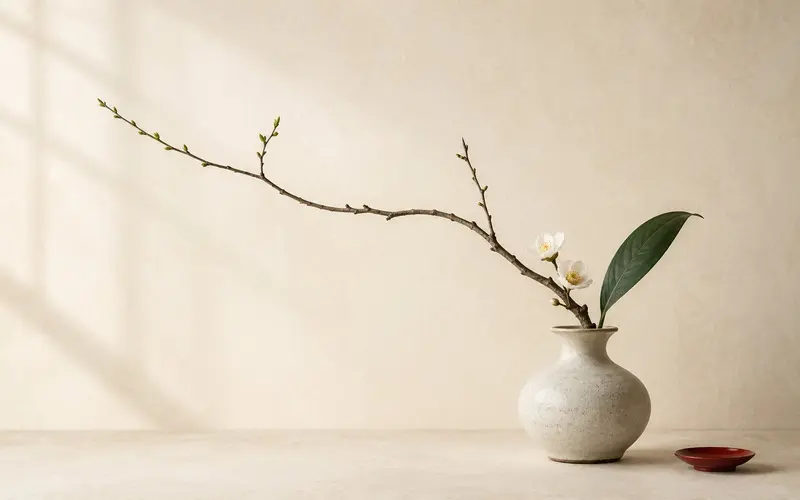
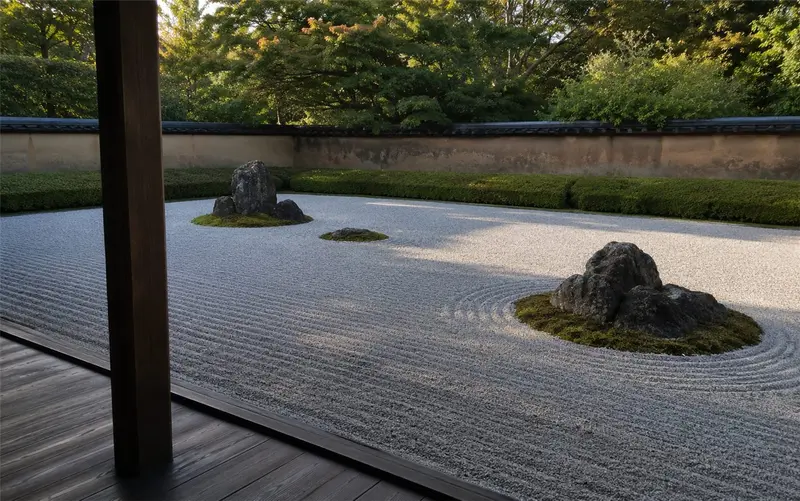
- Its relatives — ikebana, the way of flowers, and the Zen garden, a landscape condensed in stone.
Two modest kanji, tray and planting, for an art that keeps four-hundred-year-old trees alive on tables. Set one beside a scroll, leave the wall around them empty, and you have the whole Japanese idea of display: a few chosen things, and the space that lets them speak.