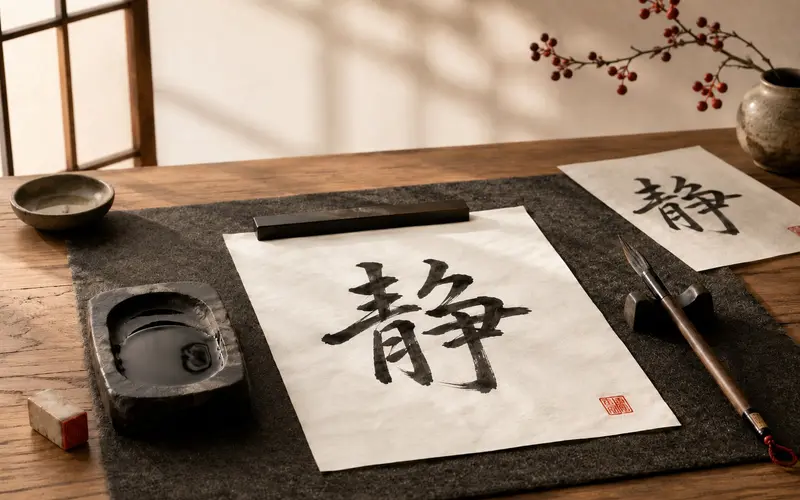
On the second day of January, Japan picks up the brush. In homes and classrooms, children kneel over long sheets of paper to finish their winter homework. And on January 5, people of every age, from pre-schoolers to adults, sit in rows on the floor of the Nippon Budokan in Tokyo and write side by side.
This is kakizome (書き初め), the first calligraphy of the year: one sheet of paper, a word chosen for the year ahead, written with full attention. It is one of the easiest Japanese New Year customs to join from anywhere, because it needs only a brush, ink, paper and a word you mean.
This guide explains what kakizome is and where it comes from, how to choose what to write, and how to do it at home, step by step. It works even if this is the first time you have held a brush.
What kakizome is
The word is simple: 書き (kaki, “writing”) plus 初め (zome, “the first time”). The same kanji 初 appears, read hatsu, in 初詣 (hatsumōde, the first shrine visit), 初日の出 (hatsuhinode, the first sunrise) and 初夢 (hatsuyume, the first dream). Japan treats the first of everything in a new year as a small ceremony, and the first writing is one of them.
Kakizome is usually done on January 2, the customary day for beginning the year’s work and practice. It has older names too: 吉書 (kissho), 初硯 (hatsusuzuri, “first inkstone”) and 筆始め (fudehajime, “first brush”). In haiku, kakizome is a season word for the New Year.
It has two purposes. One is a wish to write better in the year to come. The other is to set down in ink, where you will see it, what you want that year to be.
Where the custom comes from
Kakizome began at court. From the Heian period (794–1185), nobles, and later the warrior houses, marked the New Year and other fresh starts, such as a change of era name, with a ceremonial first document called a kissho (吉書, “auspicious writing”). In the Edo period (1603–1868), as the small local schools called terakoya taught more and more children to read and write, the first writing of the year became a custom of ordinary households. From the Meiji era (1868–1912) onwards, calligraphy lessons in the new school system helped carry it across the country.
The traditional form had four fixed points:
- Fresh water. The ink was ground with wakamizu (若水), the first water drawn on New Year’s morning.
- A lucky direction. The writer faced that year’s ehō (恵方), the direction considered fortunate for the year.
- Auspicious words. People wrote congratulatory verses and phrases, often in front of the household altar or a picture of Sugawara no Michizane, the scholar revered as the god of learning, and offered the sheet with a prayer to improve.
- Fire. The sheets stayed on display until the “Little New Year” in mid-January. Then they went into the bonfires known as dondo-yaki or sagichō, together with the New Year decorations. If the burning paper rose high into the air, it meant your hand would improve.
For more on how brush writing reached ordinary people, see A Brief History of Japanese Calligraphy.
Kakizome in Japan today
At home the custom is quieter than it once was, but in schools it is very much alive. Kakizome is a standard piece of winter-holiday homework, written large on long, narrow paper. A common size, called yatsugiri, is about 17.5 × 68 cm: narrower than a sheet of ordinary practice paper (hanshi, about 24 × 33 cm) and roughly twice as long.

The best-known public kakizome takes place at the Nippon Budokan, the Tokyo hall better known abroad for martial arts and concerts. Every January 5 it hosts a national kakizome event (全日本書初め大展覧会), a New Year fixture since the hall opened in the 1960s. The event on January 5, 2027 will be the 63rd. Each participant gets a set phrase for their age group, two sheets of paper, no model to copy and 24 minutes. They hand in one sheet.
Japan also closes each year with a single brushed character. The “Kanji of the Year” is chosen by public vote and written with a large brush at Kiyomizu-dera temple in Kyoto each December. In December 2025 it was 熊 (kuma, “bear”). Kakizome is the mirror image of that: instead of one character that sums up the year behind you, you choose one for the year ahead.
What to write
There is no rule about what to write. Schoolchildren are given set words. Adults usually write a hope or a resolution for the year. Three kinds of choice work well.
One kanji: the best choice for a first kakizome
A single large character fills a sheet of hanshi, needs no special paper, and makes you decide what you actually want. Pick the wish first, then the character:
| If you want the year to bring… | Write |
|---|---|
| A goal worth chasing | 夢 (yume, dream) |
| Good fortune for your household | 福 (fuku, good fortune) |
| Happiness | 幸 (sachi or kō, happiness) |
| Calm, and getting along with people | 和 (wa, harmony) |
| A path to stay on | 道 (michi or dō, the way) |
| Acting from the heart | 心 (kokoro, heart) |
| Light after a hard year | 光 (hikari, light) |
| A win: an exam, a match, a launch | 勝 (katsu or shō, victory) |
| Strength and health | 力 (chikara, strength) |
| Patience | 忍 (nin, endurance) |
Each link leads to a page that explains what the character really means in Japan and how to write it. The full list of 42 characters is on the kanji page.

A New Year word
These are the words of the season itself. Most have two to four characters, so they suit long paper.
- 新春 (shinshun): “new spring”, meaning the New Year.
- 初日の出 (hatsuhinode): the first sunrise of the year.
- 初夢 (hatsuyume): the first dream of the year.
- 希望の光 (kibō no hikari): the light of hope.
- 飛翔 (hishō): soaring, taking flight.
- 挑戦 (chōsen): a challenge taken on.
A four-character phrase
Japanese has a large stock of four-character sayings (四字熟語, yojijukugo), and adults often choose one as a resolution.
- 一期一会 (ichigo ichie): “one time, one meeting”. This moment will not come again.
- 初志貫徹 (shoshi kantetsu): carry your first intention through to the end.
- 有言実行 (yūgen jikkō): do what you said you would do.
- 七転八起 (shichiten hakki): fall seven times, rise eight.
Four characters need long paper and a steady hand. If this is your first kakizome, save them for another year.
For 2027: the Year of the Sheep
2027 is the Year of the Sheep (often called the Goat in English) in the twelve-year zodiac. In the traditional calendar it is the year 丁未 (hinoto-hitsuji). The zodiac sign is written 未 (hitsuji), not 羊, the everyday kanji for the animal, although both are read hitsuji here.
未 makes a good seasonal kakizome for another reason. Its basic meaning is “not yet”: it is the first character of 未来 (mirai), “the future”, literally “what has not yet come”. Five strokes, and a whole year still ahead.
How to choose
- Meaning first. A dictionary gloss is not always what a character means to a Japanese reader. Read about it before you commit; the kanji index is a good place to start.
- Fewer strokes is not easier. 心 has four strokes and nowhere to hide. Choose by meaning, then practise the shape.
- Choose something you can live with. A kakizome is meant to be looked at for weeks, or all year.
How to do kakizome at home
What you need
| Tool | For a first kakizome |
|---|---|
| Brush | One medium or large brush. See how to hold it. |
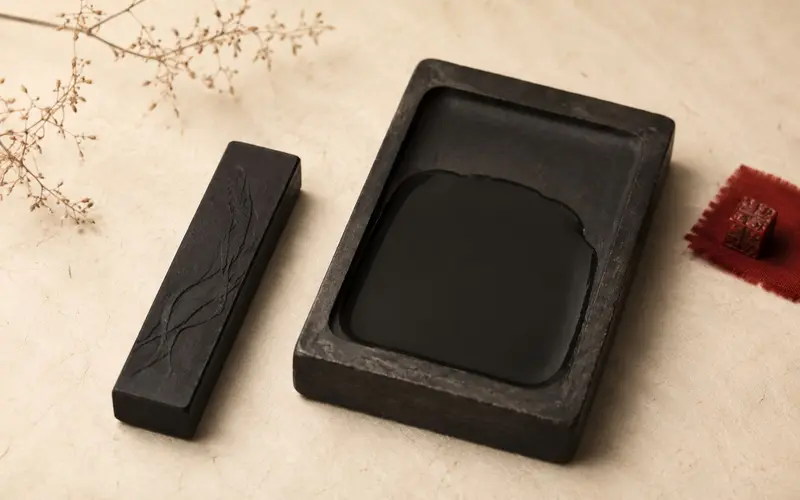
| Ink | Bottled sumi ink is fine. Grinding an ink stick is slower and makes a better ritual. |
| Paper | Hanshi, at least twenty sheets, so that you can warm up and still have several tries. |
| Felt mat and paperweight | The mat protects the table and gives the brush a soft surface; the weight keeps the paper still. |
| Small brush or brush pen | For your name. |
| Also | Newspaper, a cup of clean water, and a cloth. |
If you are starting from nothing, the beginner set guide explains what is worth buying. The short version is the Yasutomo Bokuju Sumi Set (two brushes, ink and a dish), a 100-sheet pack of hanshi and a Kuretake felt mat. For the signature, the Tombow Fudenosuke brush pens (a two-pack, one hard tip and one soft) are the easiest tool; the brush pen guide compares the alternatives.
A set also makes a well-timed present. Given at Christmas, it can be used for the first time on January 2; see the calligraphy gift set guide.
The steps
- Choose your word before the year ends. Then practise it a few times in December, so that January 2 is not the first time you write it. A short daily routine is enough.
- Prepare the space. Spread newspaper, then the felt mat. Lay the paper on the mat with the paperweight across the top edge. Pour the ink into the dish. For a bold character, use bottled ink as it comes rather than thinning it.
- Start with fresh water. The old custom was wakamizu, the first water drawn on New Year’s morning. The first water from your tap that morning keeps the spirit of it. Use it to grind your ink, or simply to fill the cup.
- Face the lucky direction, if you like. In 2027 the ehō is north-northwest. This is a custom, not a requirement.
- Warm up on scrap paper. A row of dots, then the single horizontal stroke 一 (ichi, “one”) a few times, then your character two or three times.
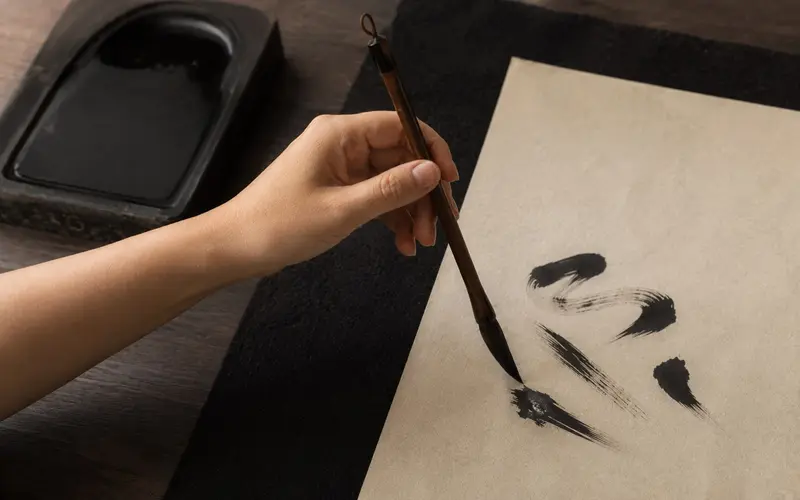
- Write. Sit straight, breathe out, load the brush fully and write the character slowly, in one go. Do not go back over a stroke to repair it. A patched stroke always shows.
- Write three to five sheets, then choose one. Lay them side by side, leave them for the length of a cup of tea, and pick the one with the most life in it. That is not always the neatest one. The Budokan rule is two sheets, one handed in.
- Sign it. With the small brush or a brush pen, write your name down the left-hand side. You can write it in katakana.
- Let it dry flat, then put it where you will see it. Tape it above your desk, or mount it on a blank hanging scroll.
- Wash the brush. Do it properly, so that it is ready for the rest of the year.
If January 2 has already passed
Any day in the New Year period counts. Japanese households treat the season as lasting until January 7, or January 15 in some regions. Outside Japan, nobody is checking the calendar.
What to do with it in mid-January
In Japan, the sheets go into the dondo-yaki fire around January 15. Unless you have a safe outdoor fire, do not burn yours. Keep it instead: write the date on the back, put it in a drawer, and take it out next January. Two Januaries side by side are the most honest progress report in calligraphy.
Kakizome with children
In today’s Japan, kakizome belongs above all to schoolchildren, and it works well in a family or a classroom. Give small children hiragana rather than kanji, and big paper. ゆめ (yume, dream), そら (sora, sky) and ひので (hinode, sunrise) are common choices for the youngest writers.
The kids’ calligraphy set guide covers sets that suit children. For a version with no ink at all, water-writing cloth lets them write with plain water and watch it fade.
Common mistakes
- Taking a character from a font list or a translation app. Check what it means in Japan first.
- Too many characters for the paper. One large kanji fills a sheet of hanshi. Two or more need long paper.
- Starting too high or too far to one side. Fold the sheet lightly into quarters before you begin. The creases show you the centre.
- Thin, grey ink. Kakizome wants black.
- Repairing strokes. Leave them. The next sheet is the repair.
- Writing thirty sheets and keeping none. A tired hand writes worse. Stop at five.
Where to go next
- Choose your character: all 42 kanji, each with its meaning and how to write it.
- New to the brush? Start with Japanese Calligraphy for Beginners and how to hold the brush.
- Need tools? The best beginner set, ink and a felt mat and paperweight.
- Make it a habit: a daily practice routine for the other 364 days.
A kakizome takes a few minutes to write and a year to live with. Choose the word carefully, write it with everything you have, and put it where you will see it. That is the whole custom, and it is a good way to begin a year.
This article contains affiliate links. If you buy through them, The Slow Brush earns a small commission at no extra cost to you. See our full affiliate disclosure.