Some of the most popular phrases on Japanese calligraphy scrolls did not come from Zen monks or Chinese poets. They came from a theater. 初心忘るべからず, “never forget the beginner’s mind,” hangs in dojos, offices and classrooms across Japan. 秘すれば花, “what is hidden is the flower,” is a favourite of calligraphers who love restraint. Both were written around six hundred years ago by Zeami, the actor and playwright who shaped Noh.
This guide reads Noh through those words: what they meant to Zeami, why they suit the brush, and how to write them. Along the way it explains the theater itself, the slowest and subtlest stage in the world.
The character on paper
| Character | 能 |
| Reading | nō |
| Strokes | 10 |
| Meaning | Skill, talent, ability |
| Full name of the art | 能楽 (nōgaku), Noh together with kyōgen |
能 means skill or ability, as in 能力 (nōryoku, capability). Noh is, literally, “the accomplished art.” The character is often explained as originally picturing a bear, an animal admired for its strength; the separate character for bear, 熊, adds four dots (a form of 火) underneath.
The character has four parts: 厶 and 月 stacked on the left, two 匕 stacked on the right. Keep the left side slightly taller than the right, and let the two 匕 shapes on the right open outward, as if the character were stepping forward. Ten strokes, but a lot of corners: a good character for practising clean turns of the brush.
Zeami’s words on scrolls
Zeami Motokiyo (c. 1363–c. 1443) wrote a series of treatises on the art of performance. They were secret, passed down within his family and school, and became widely known only after they were published in the early 20th century. Today their phrases are some of the best-loved in Japanese calligraphy.
| Phrase | Reading | Meaning | Source |
|---|---|---|---|
| 初心忘るべからず | shoshin wasuru bekarazu | Never forget the beginner’s mind | Kakyō (花鏡) |
| 秘すれば花 | hisureba hana | What is hidden is the flower | Fūshikaden (風姿花伝) |
| 離見の見 | riken no ken | See yourself as the audience sees you | Kakyō |
| 時分の花 | jibun no hana | The flower of a particular time (the bloom of youth, which fades) | Fūshikaden |
初心忘るべからず is usually quoted today as “don’t forget your original enthusiasm.” Zeami meant something sharper: remember how clumsy you were as a beginner, so you never slide back; and remember that each stage of life, even old age, has its own “first time.” That makes it a natural gift for someone starting a new job, a new school or a new practice, and a natural first scroll for a calligraphy student.
秘すれば花 is about the “flower,” Zeami’s word for the living effect a performance has on its audience. The full passage says that what is hidden is the flower, and what is not hidden cannot be. Its sense is close to yūgen: depth that comes from holding something back.
離見の見 asks the performer to see themselves from outside, from the seats. Any calligrapher who has stepped back from a finished sheet and seen it for the first time knows the feeling.
How to brush them
- Vertical, one column. A phrase like 初心忘るべからず fits a tall, narrow sheet, the format of a hanging scroll. Write it top to bottom.
- Kanji larger, kana smaller. In mixed phrases, let 初心 and 忘 carry the weight, and write the kana るべからず smaller and lighter, flowing into one another.
- Choose the style to suit the words. A block style (kaisho) makes 初心忘るべからず look like a firm rule; a semi-cursive style (gyōsho) makes it feel like advice. For 秘すれば花, a light, cursive hand with plenty of white suits the meaning. (See the five classical styles.)
- Leave space. Restraint is the subject of 秘すれば花. A crowded sheet contradicts it.
Noh’s own books: the utaibon
Noh has a written tradition of its own: the 謡本 (utaibon), chant books that give the text of each play with small marks showing how it is sung. In the early 17th century, a set of beautifully printed books from Saga, near Kyoto, the so-called 嵯峨本 (Saga-bon), included editions of Noh chants on decorated paper, with lettering associated with the great calligrapher and artist Hon’ami Kōetsu. They are among the most admired books ever printed in Japan, and show how closely Noh and fine writing were linked.
What Noh actually is
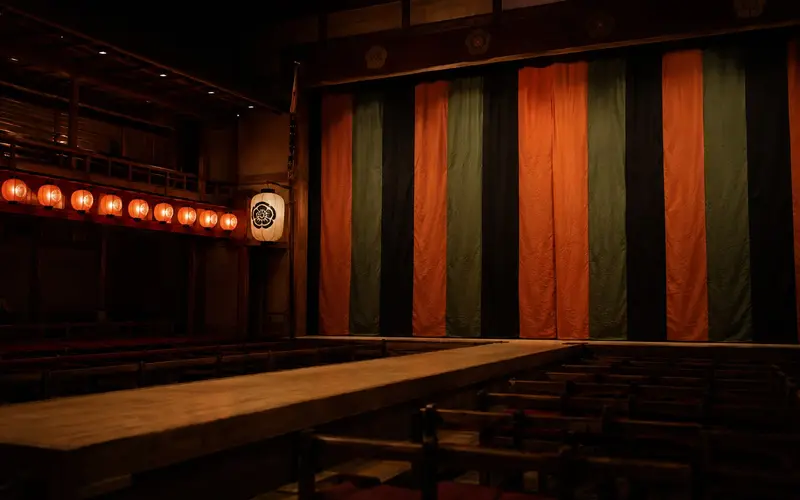
Noh took shape in the 14th century and was raised to its lasting form around 1400 by Kan’ami and his son Zeami, under the patronage of the shogun Ashikaga Yoshimitsu. It is slow, masked and stripped to essentials. The stage is a bare platform of unpainted Japanese cypress (hinoki), its only scenery a single pine painted on the back wall. Drummers and a flute player sit at the back; a chorus chants much of the text; and at the centre the masked shite, the lead, glides so smoothly the feet seem never to leave the floor.
Many great plays follow the pattern called mugen-nō, “dream Noh”: a travelling monk meets a stranger who turns out to be the ghost of someone still bound to the world by love, grief or jealousy, and the play moves slowly toward release. The sensibility is the impermanence of mono no aware.

The 能面 (nōmen, Noh mask) looks almost blank up close. On stage, tilting it up toward the light seems to brighten the face; lowering it into shadow seems to cloud it with sorrow. The actor changes the expression by changing the angle, and you finish the face yourself. Between Noh plays come kyōgen, short comic pieces without masks, so laughter resets the audience before the next long play.
Noh and the brush
Noh and calligraphy work on the same principle. Both leave things out. The pause in a Noh play and the white of the paper are the same idea, ma: space that carries meaning. Both are also fixed forms with tiny freedoms inside them. Every step and tilt in Noh is set by centuries of training, just as a calligrapher’s freedom lives inside the stroke order. And both are judged by an effect that cannot be pointed to, what Zeami called the flower.
What Noh is not
It is not kabuki. Kabuki is younger, louder and made for townspeople, with painted faces, not masks.
It is not improvised or vague. Every movement is fixed and handed down within hereditary schools.
The masks are not expressionless. They are made neutral so they can be played bright or dark by angle.
Its famous phrases are not modern slogans. 初心忘るべからず and 秘すれば花 are about six centuries old, from treatises on acting.
How to watch it
- Read the play first. Knowing the story frees you to watch how it is told.
- Stop waiting for events. Watch as you would watch one long brushstroke being laid down.
- Give it twenty minutes. Many people cross over from restlessness to absorption once they stop resisting the pace.
Where to go next
- The aesthetic it lives on — yūgen, subtle and suggested depth.
- The empty space it uses — ma.
- Its loud opposite — kabuki and its kanteiryū lettering.
- Hang the words yourself — blank hanging scrolls, and the five classical styles to choose a hand.
- The impermanence in its ghosts — mono no aware.
Noh is the theater that bet everything on suggestion, and its master left behind words that outlived the stage. Six hundred years on, 初心忘るべからず still hangs over people starting something new. Write it once, slowly, in a single column, and you will be practising the beginner’s mind it asks for.