Walk past a kabuki theater in Tokyo or Kyoto and the first thing you see is not an actor but lettering: tall boards and banners covered in fat, rounded, black characters, so heavy that hardly any white shows between the strokes. It looks like no calligraphy taught in school, and that is the point. Kabuki invented its own hand, kanteiryū, for a single purpose: to fill the seats.
This guide starts with that lettering, explains what the three characters of 歌舞伎 really say, and then sketches the theater itself: a pop spectacle founded by a woman and built to be outrageous.
The word on paper
| Word | 歌舞伎 |
| Reading | kabuki |
| Characters | 歌 (song) · 舞 (dance) · 伎 (skill, artistry) |
| Strokes | 歌 14 · 舞 15 · 伎 6 |
| Origin of the word | 傾く (kabuku), “to lean, to tilt” |
The three characters fit the art well, but they came afterwards. The word is older: 傾く (kabuku), “to lean” or “to tilt.” In the early 1600s, kabukimono, “the tilted ones,” were swaggering young nonconformists in outrageous clothes. To be kabuki was to be gaudy and unconventional on purpose. When a bold new kind of performance arrived, the name stuck, and characters were fitted to its sound. In the Edo period it was also often written 歌舞妓, with 妓, a female entertainer, a reminder of the theater’s beginnings.
Writing 歌舞伎 is a good lesson in proportion. 歌 and 舞 are both dense, and 伎 is light. Keep the first two from growing; give 舞 its wide sweeping strokes at the bottom; and let the simpler 伎 finish the word without shrinking to nothing.
Kanteiryū: lettering that wishes for a full house
勘亭流 (kanteiryū) is generally credited to Okazakiya Kanroku, known as Kantei, who is said to have written a signboard for Edo’s Nakamura-za theater around 1779. His style caught on, took his name, and became the lettering of kabuki.
What makes it recognisable:
- Thick, round strokes. Lines are fattened and their ends rounded off, with few sharp points.
- Strokes curling inward. The ends of strokes turn in toward the centre of the character. The usual explanation is that the lettering “draws the audience in.”
- Almost no white space. Each character fills its box, the strokes nearly touching. A board packed with ink is a wish for a theater packed with people.
The same superstition produced other styles of Edo lettering: 相撲字 (sumō-ji) for sumo ranking sheets, the lettering of rakugo halls, and the chunky names on lanterns and on the 千社札 (senjafuda) slips pasted at old shrines. These are often grouped together as 江戸文字 (Edo-moji). Kanteiryū is the roundest and most theatrical of them; sumō-ji is heavier and more square-shouldered.
For anyone learning calligraphy, kanteiryū breaks the usual rules on purpose. Ordinary practice prizes the balance of black and white inside a character. Kanteiryū smothers it. It is a reminder that “good” writing depends on what the writing is for.
Where to see it
- Signboards and banners. Kabuki theaters hang boards with the program and actors’ names in kanteiryū.
- The maneki of Kyoto. Each year, ahead of the December 顔見世 (kaomise) performances at Kyoto’s Minamiza theater, wooden boards called まねき (maneki, “beckoning”) are raised along the front of the building, each bearing an actor’s name in kanteiryū. The raising itself is a seasonal event in the city.
- Playbills. Kabuki’s printed playbills and cast lists, also called 番付 (banzuke) like sumo’s ranking sheet, carried the same lettering.
- 千穐楽. The last day of a run, senshūraku, is often written with 穐 instead of 秋, an old habit usually explained as avoiding the 火 (fire) inside 秋, unlucky in crowded wooden theaters. Sumo does the same.
Trying kanteiryū yourself
Kanteiryū is a specialist hand, normally learned from a teacher, but you can get a feel for it at home. Use a larger brush than usual and load it heavily. Write a simple character such as 大 (big) in your normal block style first. Then write it again, letting each stroke swell until it nearly touches its neighbours, rounding every end, and turning the tips of the strokes back toward the centre. You will find it is much harder to fill a space evenly than to leave it empty, which is exactly why the professionals’ boards look so solid. Compare the two versions side by side: the first is a character; the second is a wish.
The woman who started it
By tradition, kabuki begins in 1603, when Izumo no Okuni, a woman said to have served at the Izumo shrine, led a troupe in a new kind of dance-drama in the dry bed of the Kamo River in Kyoto. It was sensual, comic and wildly popular. The early form, onna-kabuki, “women’s kabuki,” was performed by women.
It was also tied to the pleasure quarters, and the government disapproved. Around 1629 women were banned from the stage. Young men took over until they too were banned around 1652. What remained was kabuki performed by adult men, including the onnagata, specialists in female roles. The most famous fact about kabuki, that men play every part, is the reverse of how it began.
What makes kabuki kabuki
- 見得 (mie). At a climax, the actor freezes into a powerful pose, eyes crossed, while the audience roars.
- 隈取 (kumadori). Bold painted makeup: red lines for heroes and passion, blue or black for villains and the supernatural.
- 花道 (hanamichi). A raised walkway through the audience, for grand entrances and exits.
- 回り舞台 (mawari-butai). The revolving stage, an 18th-century Japanese invention.
- Inherited names. Stage names such as Ichikawa Danjūrō pass down through generations like titles.

Kabuki was the heart of Edo’s “floating world.” Its actors were celebrities, and a whole genre of ukiyo-e, the actor print, existed to sell their images. Those prints carry writing too: actors’ names and roles brushed into the design.
What kabuki is not
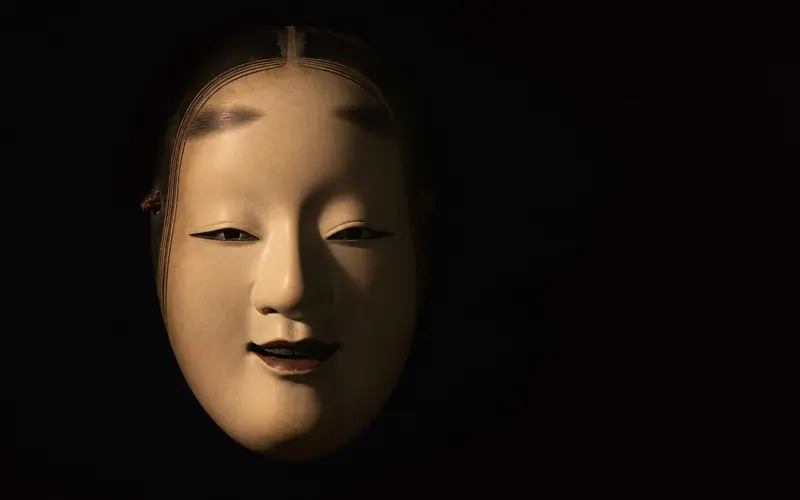
It is not Noh. Noh is the older, slow, masked theater of the samurai elite. Kabuki is younger, louder, and was made for townspeople.
It was not all-male by design. That is the result of 17th-century bans. The founder was a woman.
Its lettering is not “bad calligraphy.” Kanteiryū is a deliberate, skilled style with its own rules, practised by specialists.
It is not stuffy. Audiences shouted praise (kakegoe), ate and drank through long programs, and treated the theater as a day out.
How to watch, and read, kabuki
- Look at the front of the theater first. Find the kanteiryū boards and banners, and notice how little white is left.
- Buy a single-act ticket. Tokyo’s Kabukiza sells single-act seats, the cheapest way in.
- Rent the English guide. An audio or subtitle guide explains the plot and conventions as they happen.
- Keep the program. It is a small collection of kabuki lettering to take home.
Where to go next
- The same lucky lettering — sumo and its sumō-ji ranking sheet.
- More Edo lettering — Shinto shrines, where senjafuda slips still cling to old gates.
- The prints that sold its stars — ukiyo-e, and how to read the writing on them.
- The chic of the same world — iki, the cool of Edo’s townspeople.
- The rules kanteiryū breaks — the five classical styles of calligraphy.
- Its costumes and companions — the kimono and the geisha.
Kabuki began as the deliberately strange spectacle of a riverbed dancer and grew into the roaring pop theater of a whole city, with its own celebrities, its own prints, and its own fat, inward-curling lettering. The boards outside still say what the theater has always wanted: every seat filled, as full as the characters are with ink.