A sumo bout often lasts about four seconds. The sheet of paper that tells you who is fighting whom takes far longer to make: every name on it, from the grand champions down to the newest teenage recruits, is brushed by hand by a referee, in a style of lettering so thick and crowded that the paper almost disappears under the ink.
That style is called sumō-ji, and it is a good way into sumo as a whole. Like the sport, it looks strange until you know the reasons, and then every detail turns out to be deliberate. This guide starts with the ritual, then reads the ranking sheet line by line, and ends with how to write 相撲 yourself.
A sport that started as a prayer
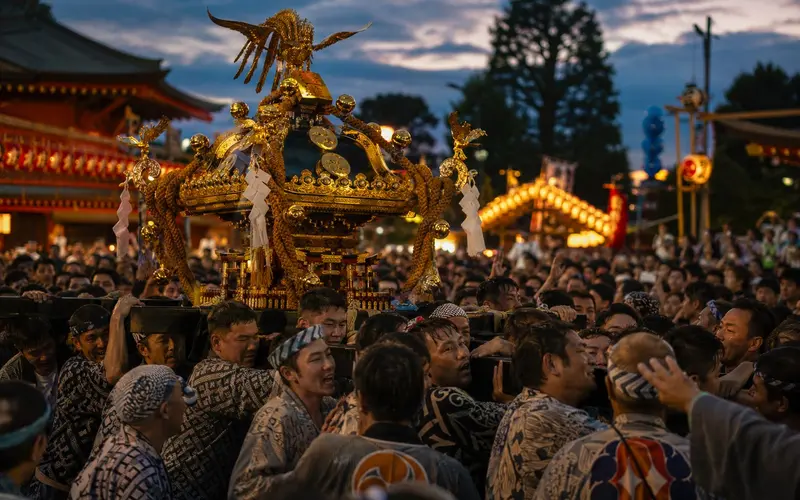
相撲 (sumō) began not as a sport but as a Shinto rite, performed at shrines to entertain the kami and pray for a good harvest. It appears in Japan’s oldest chronicles, from the 8th century. The professional sport grew out of this sacred practice and never quite left it.
Watch a single bout and the rite is everywhere:
- The ring. The 土俵 (dohyō), a raised platform of clay, is purified sacred space, under a roof modelled on a shrine’s.
- The salt. Wrestlers fling salt across the ring before they fight: Shinto purification.
- The stamping. The high leg-raise and stamp, 四股 (shiko), is meant to drive evil spirits out of the ring.
- The referee. The 行司 (gyōji) is dressed like a Shinto priest.
- The rope. The grand champion wears a thick white rope, a cousin of the shimenawa that marks sacred ground at a shrine.
The minutes of “stalling” before a bout are purification and preparation. The four seconds of wrestling are real and ferocious, and they are the shortest part of the ceremony.

The referees who are also calligraphers
The gyōji do much more than referee. They announce the wrestlers, keep the ritual in order, and, less visibly, they write. The official documents of the sport are brushed by gyōji, and learning to write sumō-ji is part of a referee’s training.
The most important of those documents is the 番付 (banzuke), the ranking sheet issued before each grand tournament. A senior gyōji brushes the original by hand; it is then reproduced and sold to fans. It is one of the few mass-printed documents in modern Japan that begins life as a single piece of calligraphy.
How to read a banzuke
A banzuke looks like a wall of black. It is in fact very orderly.
| Where | What you see |
|---|---|
| Top centre | 蒙御免 (gomen kōmuru), “with permission,” a phrase kept from the Edo period, when public tournaments needed official approval |
| Right half | The East side (東) |
| Left half | The West side (西) |
| Top row, largest | The top division (makuuchi): grand champions (横綱 yokozuna), champions (大関 ōzeki) and the rest |
| Rows below | The lower divisions, in smaller and smaller writing |
| Bottom row | The lowest division, jonokuchi, written so small it is nicknamed 虫眼鏡 (mushimegane), “magnifying glass” |
| Bottom centre | 千穐万歳大々叶 (senshū banzai dai-dai kanō), a closing wish for lasting prosperity |
The size of a wrestler’s name on the sheet is, quite literally, his status. Climbing the banzuke means seeing your name written larger.
Look closely at the closing phrase and you may notice 穐 where you would expect 秋 (autumn) in 千秋 (senshū). This variant is a well-known habit of sumo and the theatre, often explained as a way of avoiding the 火 (fire) inside 秋, an unlucky element for crowded wooden halls. The final day of a tournament, senshūraku, is often written 千穐楽 for the same reason.
Why sumō-ji is so heavy
Sumō-ji is thick, square-shouldered and packed tight. The strokes are fattened and pushed out to the edges of each character’s space, so that very little white paper shows between them.
The reason is a piece of happy superstition: a sheet filled with ink is a wish for a hall filled with people. The same idea produced kabuki’s rounded kanteiryū lettering for theatre signboards, and the lettering of rakugo halls and festival lanterns. These styles are often grouped together as 江戸文字 (Edo-moji), the commercial lettering of old Tokyo. Kabuki and sumo, two very different worlds, arrived at the same answer to the same wish: a full page means a full house.
For a calligrapher, sumō-ji runs against almost everything taught in ordinary practice. Ordinary calligraphy prizes the balance of black and white, the breathing space inside a character. Sumō-ji deliberately chokes it. That is why it is worth knowing: it shows how much the “rules” of good writing depend on what the writing is for.
More brushwork around the ring
- The kaobure gonjō. On tournament days, a senior gyōji stands in the ring and reads out the next day’s top-division bouts from brush-written sheets in sumō-ji, holding each one up to the crowd. It is a short, formal piece of theatre built around calligraphy.
- Tegata. Wrestlers in the top two divisions make 手形 (tegata), handprints in ink on squares of card, signed with a brush. They are given to supporters and sold as souvenirs, and they let you compare your hand with a wrestler’s.
- Nobori. Outside the arena, tall coloured banners (幟, nobori) carry wrestlers’ names in large brush lettering, gifts from their supporters.
Writing 相撲
| Word | 相撲 |
| Reading | sumō (すもう), a reading of the whole word (jukujikun) |
| Characters | 相 (sō, mutual, together) · 撲 (boku, to strike) |
| Strokes | 相 9 · 撲 15 |
The reading sumō belongs to the word, not to either character: neither 相 nor 撲 is read su or mō on its own. Japan’s official kanji table lists 相撲 among its special whole-word readings. The characters describe the act (“striking each other”), and the native word supplies the sound.
相 is 木 (tree) beside 目 (eye). Keep 木 narrow and let 目 stand slightly taller. 撲 is wide and busy, with the hand radical 扌 on the left and fifteen strokes in all. Keep the 扌 slim and upright, and give the right side room. In ordinary block style (kaisho), aim for a calm balance of black and white. If you want to try sumō-ji, use a larger brush, load it heavily, and let each stroke swell until the gaps nearly close. It is harder than it looks to fill the space without the character turning into a blot.
What sumo is not
It is not just big men shoving. Balance, timing and technique decide bouts, and there are more than eighty recognised winning techniques.
The pre-bout delay is not time-wasting. It is the ritual of which the bout is the climax.
It is not a frozen relic. Some of the greatest modern champions have come from Hawaii and Mongolia, reshaping a deeply Japanese institution from within.
How to watch it with a calligrapher’s eye
- Find the banzuke. Look up the current ranking sheet online or buy a printed one at a tournament, and find the wrestlers you are about to watch. Notice how the size of each name tells you its rank.
- Watch the ritual, not just the clash. The salt, the stamp and the priest-like referee are the ceremony. The collision is its last few seconds.
- Catch the kaobure gonjō. If you are at a tournament or watching a full broadcast, watch for the gyōji holding up the brushed sheets of the next day’s bouts.
Where to go next
- The faith underneath it — Shinto, whose purification rites fill the ring, and whose shrines have their own calligraphy.
- The same lucky lettering — kabuki and its space-filling kanteiryū signboards.
- Kanji from the ring — 土 (earth), 力 (strength) and 勝 (victory).
- The styles it bends — the five classical styles of Japanese calligraphy, the rules that sumō-ji deliberately breaks.
Sumo is a prayer that slowly turned into a sport without ever stopping being a prayer. The salt still purifies, the stamp still drives off demons, and before each tournament a referee still sits down with a brush and fills a sheet with names, black and crowded, as a wish that the seats will be just as full.