Walk into a Japanese summer festival at dusk and the first thing you notice is the light: rows of paper lanterns strung over the street, each one glowing red or white. Look again and you will see that almost every lantern carries writing, big black characters brushed or painted across its curved belly. So do the tall banners at the shrine gate, the cotton coats of the people carrying the portable shrine, and the signboards over the stalls. A matsuri is one of the most lettered events in Japan.
This guide reads a festival through its writing: what the lanterns and banners say, how festival lettering is made, and what the kanji 祭 itself shows. Along the way it explains the Shinto rite that sits at the centre of the noise.
The word on paper
| Word | 祭り (also simply 祭) |
| Reading | matsuri (まつり); sai in compounds such as 祭日 (saijitsu, holiday) |
| Root verb | 祭る (matsuru), to enshrine, to worship |
| Strokes | 祭 11 |
| Parts | ⺼ (meat) + 又 (hand) + 示 (altar) |
祭 is usually explained as a picture of a rite: at the top left is a form of 肉, meat; at the top right is 又, a hand; underneath is 示, the altar or offering table that also appears, narrowed to 礻, in kanji such as 神 (kami) and 社 (shrine). A hand placing meat on an altar. The character says plainly what the festival was for.
The verb 祭る (matsuru) means to enshrine or worship a deity, and 祭り is its noun: the act of worship. A matsuri is, at its origin, a Shinto event held for the local kami. The party is what worship looks like when a whole community does it together.
Writing 祭 well
Eleven strokes in three parts make 祭 easy to write badly. Keep the two top parts the same height and let them sit like two shoulders; the hand 又 on the right ends in a long sweep down to the right, which should open out over the altar below. Then write 示 a little wider than you think, as a stable base: a short top horizontal, a longer one, the central vertical with a hook, and two short strokes either side. If the base is narrow, the character looks top-heavy and about to tip.
Reading festival lettering
Festival writing is short and formal. A handful of words cover most of what you will see:
| Word | Reading | Meaning | Where you see it |
|---|---|---|---|
| 奉納 | hōnō | Dedicated, offered (to the kami) | Shrine banners, lanterns, plaques |
| 献燈 / 献灯 | kentō | An offered light | Lanterns donated to a shrine |
| 御神燈 / 御神灯 | goshintō | Sacred light | Lanterns hung at house entrances during the festival |
| 祭禮 / 祭礼 | sairei | Festival rite | Banners and lanterns along the route |
| ○○町 | -chō | ○○ neighbourhood | Lanterns, happi coats |
Under or beside these you will often find a column of names: the families and businesses that paid for the lantern or banner. Their names are written smaller, and reading them is part of the pleasure. A festival is also a record of who holds the neighbourhood together.
Nobori. At the shrine entrance stand tall, narrow cloth banners (幟, nobori), usually with 奉納 at the top, the name of the shrine or the kami in large characters down the middle, and the donor’s name at the foot.
Happi and hanten. The people carrying the mikoshi wear short cotton coats (法被, happi, or 半纏, hanten) printed with the name of their neighbourhood or group on the back, often in a heavy square lettering, and sometimes simply the character 祭. The coat tells you which team someone belongs to, the way a jersey does.

How festival lettering is made
Festival lettering has to work at night, at a distance, and on a moving crowd’s glance. That shapes it.
Lantern lettering (提灯文字, chōchin-moji) is often drawn rather than simply written. A paper lantern is curved and pleated, so a single pass of the brush would skip and wobble. Lantern makers outline each character and then fill it in, building thick, even strokes that read clearly when the lantern is lit from inside. The result looks less like a calligrapher’s free stroke and more like a bold sign, which is exactly the point.
This lettering belongs to the same family as the other commercial scripts of old Tokyo, often grouped as 江戸文字 (Edo-moji): the rounded kanteiryū of kabuki signboards, the packed sumō-ji of sumo’s ranking sheets, the lettering of rakugo halls, and the names on the senjafuda slips pasted at old shrines. They share an instinct: thick strokes that fill the space, made to be seen by a crowd and, in several cases, to wish for a crowded house.
For anyone who practises calligraphy, festival lettering is a useful contrast. Ordinary brushwork values a live, single stroke and the balance of black and white. Festival lettering values legibility, weight and impact. Both are good writing for their purpose.
The god in the streets
The centre of a classic matsuri is the 神輿 (mikoshi), the portable shrine. During the festival the kami is ceremonially moved into it, and teams of bearers carry it through the neighbourhood on their shoulders, rocking it and chanting, often “wasshoi.” The god leaves home and travels through the community, and its passage blesses the streets it moves along.
Alongside come the great wheeled floats, 山車 (dashi). The reading dashi belongs to the word as a whole: neither 山 (mountain) nor 車 (vehicle) is read that way on its own, and the word is listed among the special whole-word readings in Japan’s official kanji table, like 相撲 (sumō). Drums, flutes and the strain of the carrying make it loud and physical, and entirely sacred all the same.
The reasons and the seasons
- Spring festivals pray for a good planting.
- Summer festivals often drive out what summer brings: disease and bad spirits. Kyoto’s Gion Matsuri traces back to a rite held in 869 during an epidemic.
- Autumn festivals give thanks for the harvest.
- Obon, in midsummer, is Buddhist rather than Shinto: ancestral spirits are welcomed home, and communities dance the Bon Odori. The two traditions braid through the festival year.
A few landmarks: Kyoto’s Gion Matsuri (July) and ancient Aoi Matsuri (May), which appears in the Tale of Genji in the famous quarrel over a viewing spot; Aomori’s Nebuta (August), with giant illuminated paper floats; Tokushima’s Awa Odori, a city-wide dance; and Osaka’s Tenjin Matsuri (July), with boats and fireworks.
What a matsuri is not
It is not just a street party. The food and games grew around a religious core. The heavy golden thing in the middle is a shrine.
It is not one event. There are thousands of matsuri, each tied to its own shrine, kami and day.
The mikoshi is not a parade float. It carries a deity; the rocking is the god travelling among the people.
The lettering is not decoration. It names the kami, the offering and the people who made the offering.
How to see a festival with a calligrapher’s eye
- Read the lanterns. Look for 奉納, 献燈 or 御神燈, then for the neighbourhood name and the donors underneath.
- Look at the coats. The lettering on the backs of the happi tells you which teams are carrying.
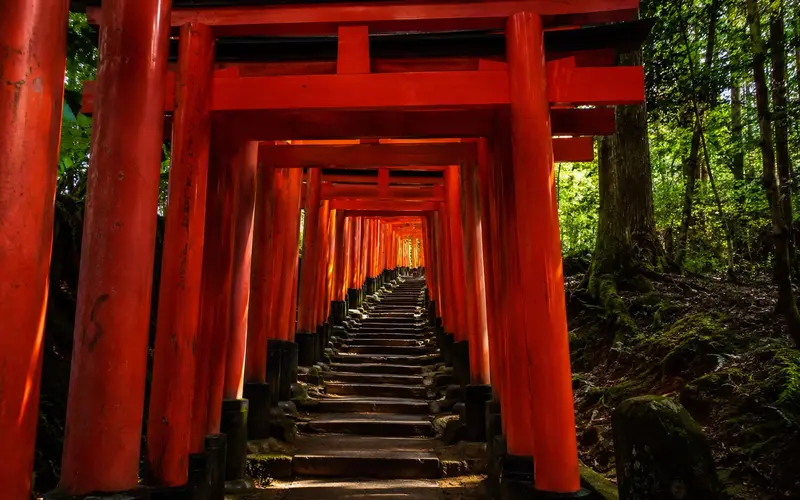
- Find the oldest writing. At the shrine itself, look for the name plaque on the torii, old stone lanterns with carved inscriptions, and, at some shrines, faded senjafuda high on the gate.
- Try 祭 yourself. A brush pen is enough to practise the balance of the three parts.
Where to go next
- The faith underneath it — Shinto, and the writing found at every shrine.
- The same family of lettering — kabuki’s kanteiryū and sumo’s sumō-ji.
- The other great seasonal gathering — hanami, cherry-blossom viewing.
- What everyone is wearing — the kimono and its summer cousin the yukata.
- The fleeting beauty it trades in — mono no aware.
A matsuri is the moment a community walks its god around the block, and it writes the whole event down as it goes: the kami’s name on the banners, the offering on the lanterns, the teams on their backs. The character 祭 says the same thing in eleven strokes: a hand, an offering, an altar. Go for the food, and read the lanterns while you queue.