Shinto has no founder, no holy book and no creed. You might expect a religion without a scripture to have little to do with writing. In fact, a Shinto shrine is one of the places where ordinary Japanese people meet the brush most often: in the seal-and-ink record of a visit, in the wishes hung on wooden plaques, in the name over the gate, and in the paper talismans taken home.
This guide reads a shrine through its writing. It explains the Shinto ideas you need to understand what you are looking at, then shows how to read a goshuin, what to write on an ema, and where else the brush turns up.
The way of the kami, briefly
神道 reads Shintō, “the way of the kami.” The second character is 道 (dō, the way), the same “way” as in judō, kendō and shodō, the way of writing. Shinto is a path of practice more than a body of belief.
At its heart are the kami (神). “God” is a poor translation. A kami is a sacred presence that can dwell in a mountain, a waterfall, an old tree wrapped in rope, the sun, the rice in the field, a remarkable person or an ancestor. Tradition speaks of 八百万の神 (yaoyorozu no kami), the “eight million kami,” meaning a number beyond counting.
The other key idea is purity. Shinto cares less about sin than about cleanliness and pollution, harae and kegare: rinsing the hands and mouth, purifying with salt, water and wind. You will see this at every shrine, starting at the water basin by the entrance.
A shrine (神社, jinja) is marked by its 鳥居 (torii), the two-pillared gate that separates ordinary space from sacred space. The visit has a simple shape: bow at the torii, purify at the basin, then at the offering hall make a small offering and perform two bows, two claps, one bow (a few shrines, such as Izumo Taisha, use four claps).

The goshuin: a piece of calligraphy made in front of you
A 御朱印 (goshuin, literally “honourable vermilion seal”) is a record of your visit, written by hand into a folding book called a 御朱印帳 (goshuin-chō). At many shrines a priest or attendant writes it while you wait, in brush and ink, then presses the vermilion seals. For anyone interested in calligraphy, it is the most accessible live brushwork in Japan.
How to read one
Most shrine goshuin follow the same layout, read in vertical columns from right to left:
| Where | What it says | Example |
|---|---|---|
| Upper right | 奉拝 (hōhai), “respectfully worshipped” | 奉拝 |
| Centre, large | The name of the shrine | ○○神社, ○○宮, ○○大社 |
| Over the centre | The shrine’s vermilion seal (often square) | — |
| Left | The date of the visit | 令和八年十月二十二日 |
| Here and there | Extra seals: crests, seasonal motifs, festival marks | — |
The date usually uses the Japanese era name: 令和 (Reiwa), then the year, month and day in kanji numerals. The centre is written fastest and most freely, often in a semi-cursive hand (gyōsho), so it can be hard to read even for Japanese visitors. The seal underneath usually carries the same name, often in an old seal script, and the shrine’s own signboard gives it in plain type; between the three you can usually work it out. (For more on reading brush writing and seals, see how to read a Japanese calligraphy scroll.)
Temples give goshuin too, with a similar layout; the centre there usually names the main Buddha or hall rather than a shrine.
How to ask for one
- Pray first. A goshuin is proof of a visit, not a souvenir bought instead of one.
- Find the counter. It is usually at the shrine office (社務所, shamusho) or a booth marked 御朱印.
- Hand over your book open at a blank page and say “goshuin o onegai shimasu.”
- Make the offering. At shrines it is called 初穂料 (hatsuho-ryō) and is usually a few hundred yen. Some shrines show the amount on a sign.
- Wait, and watch. If the writing is done in front of you, it is worth watching how the writer loads the brush and moves through the name in one go.
Some shrines hand out pre-written sheets (書き置き, kakioki), especially at busy times; you paste them into your book. Many people keep separate books for shrines and temples, and a few places prefer that you do.
The ema: wishes in your own hand
An 絵馬 (ema, “picture horse”) is a small wooden plaque with a picture on one side and a blank space on the other. You write your wish, then hang it on a rack with hundreds of others. The name recalls an old custom of offering horses to the kami; a painted horse took the place of a real one.
Ema are where visitors write rather than receive. Many wishes are written as short set phrases, which also make good first practice in writing kanji with a pen or brush:
| Phrase | Reading | Wish |
|---|---|---|
| 合格祈願 | gōkaku kigan | Passing an exam |
| 家内安全 | kanai anzen | Safety of the household |
| 商売繁盛 | shōbai hanjō | A thriving business |
| 安産祈願 | anzan kigan | A safe birth |
| 縁結び | en-musubi | Finding a good match |
| 無病息災 | mubyō sokusai | Good health |
You can write in any language. A few tips: write vertically from the top if you write in Japanese; keep the phrase large and your name smaller below it; and leave out your address, or use initials, since ema hang in public.
Other writing at a shrine
- The name plaque on the torii. Many torii carry a framed plaque, a 神額 (shingaku), with the shrine’s name brushed large, often by a notable person. It is the first piece of calligraphy you pass under.
- Ofuda. Paper talismans, お札 (ofuda), carry the name of the kami and the shrine, stamped or brushed, to be kept on a household altar.
- Shide. The white zigzag paper strips hanging from sacred ropes, 紙垂 (shide), are folded from paper, traditionally washi. They mark a purified space.
- Senjafuda. At older shrines you may see narrow paper slips pasted high on gates and beams, each with a name in bold, packed Edo-style lettering. These 千社札 (senjafuda) were left by pilgrims; pasting new ones is now usually forbidden, but the old ones survive. The same chunky lettering tradition produced the scripts of kabuki signboards and sumo ranking sheets.
Writing 神道
| Characters | 神 (shin, kami) + 道 (dō, michi) |
| Strokes | 神 9 · 道 12 |
| Radicals | 神: 礻 (shimesuhen, the altar radical) · 道: 辶 (the walking radical) |
神 has the altar radical 礻 on the left, found in many kanji about the sacred (祈 to pray, 社 shrine, 祝 to celebrate). Keep the left side narrow and let the right side, 申, carry a long central vertical: that line is the spine of the character. 道 ends with the long sweep of 辶, written last, which should travel further than feels comfortable. There is more on each in the kanji for god and the kanji for way.
What Shinto is not
It is not a religion of doctrine. No founder, no scripture, no creed. It is something you do.
Kami are not almighty gods. They are sacred presences, many and local, woven into nature.
It is not exclusive. Most Japanese take part in both Shinto and Buddhism, by occasion: a baby’s first shrine visit, a Buddhist funeral. The saying goes that the Japanese are born Shinto and die Buddhist.
It is not the same as the State Shinto of 1868–1945. The government bent Shinto into a tool of nationalism in that period; that system was dismantled after the war. The quiet shrine practice is much older and continues.
Where to go next
- Read the writing — how to read a Japanese calligraphy scroll, seals included.
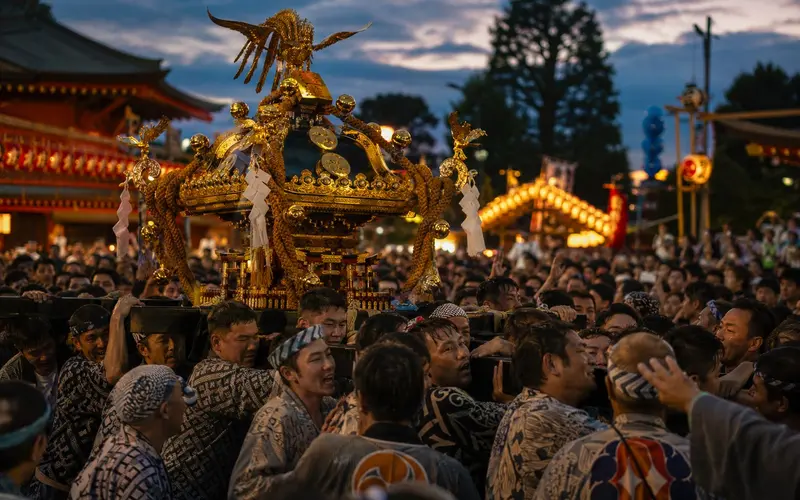
- The festivals — matsuri, when the kami is carried through the streets.
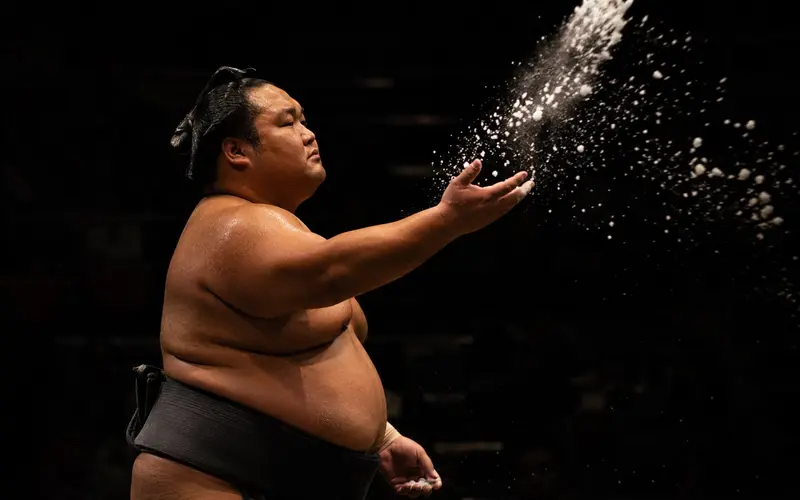
- A ritual that became a sport — sumo, purification in a clay ring, and its ranking sheet brushed in ink.
- The paper — washi, from which shide and ofuda are made.
- Write your own first characters — the complete beginner’s guide to Japanese calligraphy.
Shinto has no book, but it is not without writing. It is written in the name over the gate, the wishes swinging on the ema racks, and the wet ink of a shrine name brushed into a visitor’s book while they watch. If you visit a shrine, take a goshuin book. It turns a trip into a collection of calligraphy, each page made by hand on the day you were there.